The Drivers Reserve Blog #3 | The Corvette That Was Never Supposed to Exist
The Corvette That Was Never Supposed to Exist
What makes a Corvette worth $18.7 million?
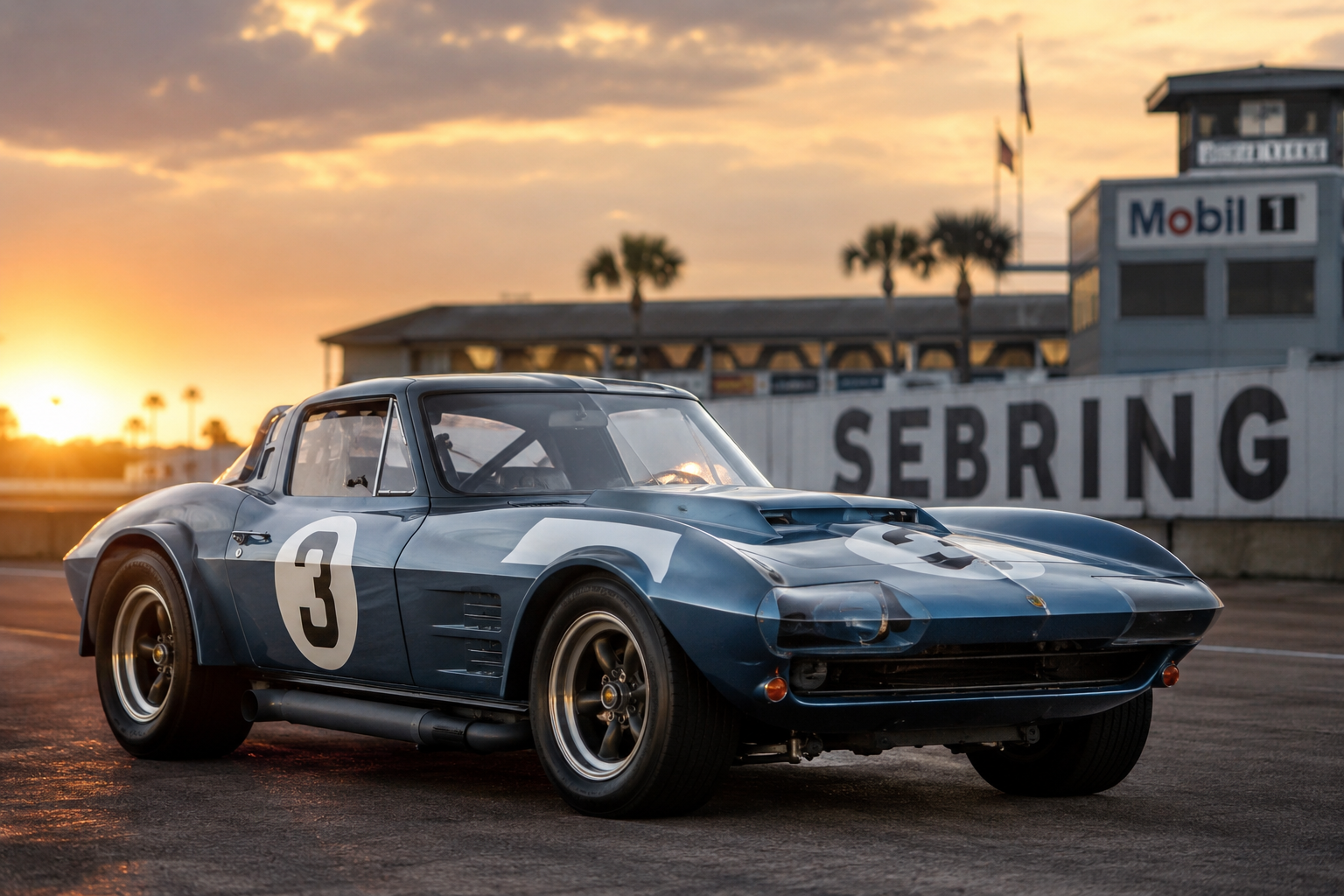
At the 2026 Monterey auction, a 1963 Chevrolet Corvette Grand Sport sold through RM Sotheby’s for $18,705,000, becoming the most valuable Corvette ever sold at auction (“1963 Chevrolet Corvette Grand Sport”). The price is incredible, the story behind the car is even better. This wasn't simply a rare Corvette. It was one of five cars created from a racing program General Motors tried to stop, and it was built with one goal in mind: beat Carroll Shelby.
By 1963, Zora Arkus-Duntov had a problem. The new Corvette Sting Ray was fast, but Carroll Shelby's Cobra was significantly lighter and proving itself on the racetrack. Duntov knew Chevrolet needed something much more serious. His answer was the Grand Sport. Although it resembled a Sting Ray, underneath it was essentially a purpose-built race car. Chevrolet used a lightweight tubular chassis, an incredibly thin fiberglass body, and lightweight materials throughout. The result weighed roughly 1,900 pounds, compared with around 3,200 pounds for a standard Corvette (“1963 Chevrolet Corvette Grand Sport”).
For the 1963 Bahamas Speed Week, the cars were equipped with all-aluminum 377-cubic-inch V-8s breathing through four Weber carburetors. Nearly 500 horsepower, roughly 2,000 pounds in 1963...
Duntov had his Cobra fighter.
There was only one problem: General Motors had officially withdrawn from factory-supported racing. When GM leadership discovered what was happening, the program was stopped. A project intended to produce far more cars ended after just five Grand Sports were completed. Fortunately, five were enough. Three Grand Sport coupes eventually made their way to John Mecom Jr.'s racing operation for the 1963 Bahamas Speed Week. Among them was chassis 003—the same car that would sell for $18.7 million more than sixty years later. The cars arrived at Nassau with massive tires, dramatically flared bodywork, and serious V-8 power. Even Carroll Shelby came over to inspect them.
Early racing revealed a problem: overheating differentials. Engineers worked to develop an external cooling solution, and the Grand Sports went back out (Thurn). Then they did exactly what Duntov had created them to do, they beat the Cobras. In the Nassau Trophy, John Cannon drove chassis 003 to second in class while Dick Thompson took the class victory in another Grand Sport. The cars had earned an appropriate nickname: “Snake Eaters.” But chassis 003 wasn't finished making history. At the 1964 12 Hours of Sebring, the car was driven by John Cannon and A.J. Foyt. Mechanical trouble during qualifying left them starting 62nd on a 66-car grid.
Then the green flag dropped.
Foyt reportedly passed around 50 cars on the opening lap (Thurn).
Imagine the scene: a Corvette Chevrolet wasn't supposed to build, starting nearly dead last at Sebring, charging through almost the entire field in a single lap. Despite further mechanical trouble, Foyt and Cannon recovered to finish second in class. Chassis 003 returned to Sebring the following year and finished third in class (“1963 Chevrolet Corvette Grand Sport”). That history alone makes the car significant. What makes chassis 003 even more remarkable is how much of it survived. Race cars tend to live brutal lives. They crash, break, get repaired, modified, and rebuilt. Decades later, determining how much remains of the original machine can become part of the challenge.
Grand Sport 003 escaped much of that fate. Its original tubular structure and lightweight fiberglass body survived, along with numerous Grand Sport-specific components. Even its dashboard and seats are believed to be original (“1963 Chevrolet Corvette Grand Sport”).
That brings us back to $18.7 million.
The buyer wasn't simply buying a 1963 Corvette.
They were buying Grand Sport 003.
One of five built. The first of three coupes. Developed under Zora Arkus-Duntov. Built to challenge Shelby, raced at Nassau and Sebring. Driven by A.J. Foyt, Jim Hall, Augie Pabst, John Cannon, and other significant names in American motorsport. Most importantly, they were buying history, you can reproduce a part, you can rebuild an engine, you can recreate a paint scheme, you cannot recreate the fact that this chassis went racing at Nassau and Sebring more than sixty years ago.
That's what makes the collector-car world so fascinating. Rarity alone doesn't make a great car. The truly exceptional automobiles combine specification, originality, condition, documentation, provenance, and history. That principle doesn't only apply to $18 million race cars. Two cars can share the same year, model, and engine and still be worlds apart in desirability. Sometimes the difference is a rare factory specification. Sometimes it's an unusual color combination. Sometimes it's exceptional originality or ownership history, and sometimes it's because Zora Arkus-Duntov built a Corvette that GM didn't really want him racing, sent it to the Bahamas to hunt Cobras, and later put A.J. Foyt behind the wheel at Sebring.
That's a little harder to replicate.
There are Corvettes, there are rare Corvettes, and then there are five Grand Sports.
One of them just sold for $18.7 million.
Not simply because it's rare.
Because history only happens once.
— The Drivers Reserve
Works Cited
“1963 Chevrolet Corvette Grand Sport.” RM Sotheby’s, The Monterey Auction, 2026.
Thurn, Walt. “The Day the Corvette Grand Sports Stomped the Cobras.” Hot Rod, 22 June 2016.